
A standing desk isn’t automatically better for your back than a sitting desk – the real answer is that neither one is good if you do it all day without moving. The healthiest setup isn’t standing or sitting; it’s alternating between the two and building movement into your day. A standing desk can genuinely help, but only if you use it the right way, and standing all day brings its own set of problems.
Why Sitting All Day Is Hard on Your Back
The case against prolonged sitting is well established. When you sit for hours, several things work against your spine at once.
Sitting places more pressure on the discs of your lower back than standing does – especially when you slump, which almost everyone does eventually as the hours wear on. It also shortens and tightens the hip flexors while lengthening and weakening the glutes and core, creating the muscle imbalances that pull the pelvis out of its healthy position over time. And sitting encourages that forward-head, rounded-shoulder posture that loads the neck and upper back.
None of this happens in an hour. It’s the accumulation – day after day, year after year – that turns prolonged sitting into chronic back pain, neck tension, and postural dysfunction.
So Is a Standing Desk the Answer?
Standing desks became popular as the antidote to all that sitting, and they do offer real benefits. Standing engages your postural muscles, takes the concentrated disc pressure off your lower back that sitting creates, and makes it easier to keep your spine in a more neutral position. For a lot of people, switching to a standing desk for part of the day noticeably reduces their back and neck discomfort.
But here’s the catch: standing all day isn’t the solution either. Prolonged standing has its own downsides – it can cause lower back fatigue, foot and leg discomfort, and problems from locking the knees or shifting weight poorly. People who go from sitting all day to standing all day often just trade one set of complaints for another.
The standing desk isn’t a cure. It’s a tool – and like any tool, it only helps if used correctly.
The Real Answer: Movement and Variety
What your spine actually wants isn’t a single perfect position – it’s variety and movement. The spine and its supporting muscles are built to move, and any position held too long, standing or sitting, causes problems.
The healthiest approach is to alternate. Spend some time sitting, some time standing, and – most importantly – break up both with actual movement. A common recommendation is to change positions roughly every 30 to 60 minutes and to take short movement breaks throughout the day: stand up, walk around, stretch, roll your shoulders. The best posture really is your next posture.
A height-adjustable desk that lets you switch between sitting and standing is ideal precisely because it makes that alternating easy. If you have a standing desk, the goal isn’t to stand all day – it’s to have the option to shift whenever you’ve been in one position too long.
Setting Up Either Position Correctly
Whichever you’re doing at any given moment, setup matters.
When Sitting
Keep your feet flat on the floor, knees roughly level with your hips, and your lower back supported – a chair with lumbar support or a small cushion helps maintain the natural curve. Your screen should be at eye level so you’re not looking down, and your elbows should rest at about 90 degrees.
When Standing
Keep your weight balanced evenly on both feet, avoid locking your knees, and stand tall without arching your lower back. Your screen should still be at eye level, and an anti-fatigue mat can make a real difference in comfort during standing stretches. Shifting your weight and moving your feet periodically helps too.
When Desk Pain Won’t Go Away
Sometimes people do everything right – the adjustable desk, the good chair, the movement breaks – and still deal with nagging back or neck pain. That usually means the desk setup was contributing to a problem that has now taken on a life of its own: joint restrictions, muscle imbalances, or postural patterns that have become structural and won’t resolve on their own no matter how good your ergonomics get from here forward.
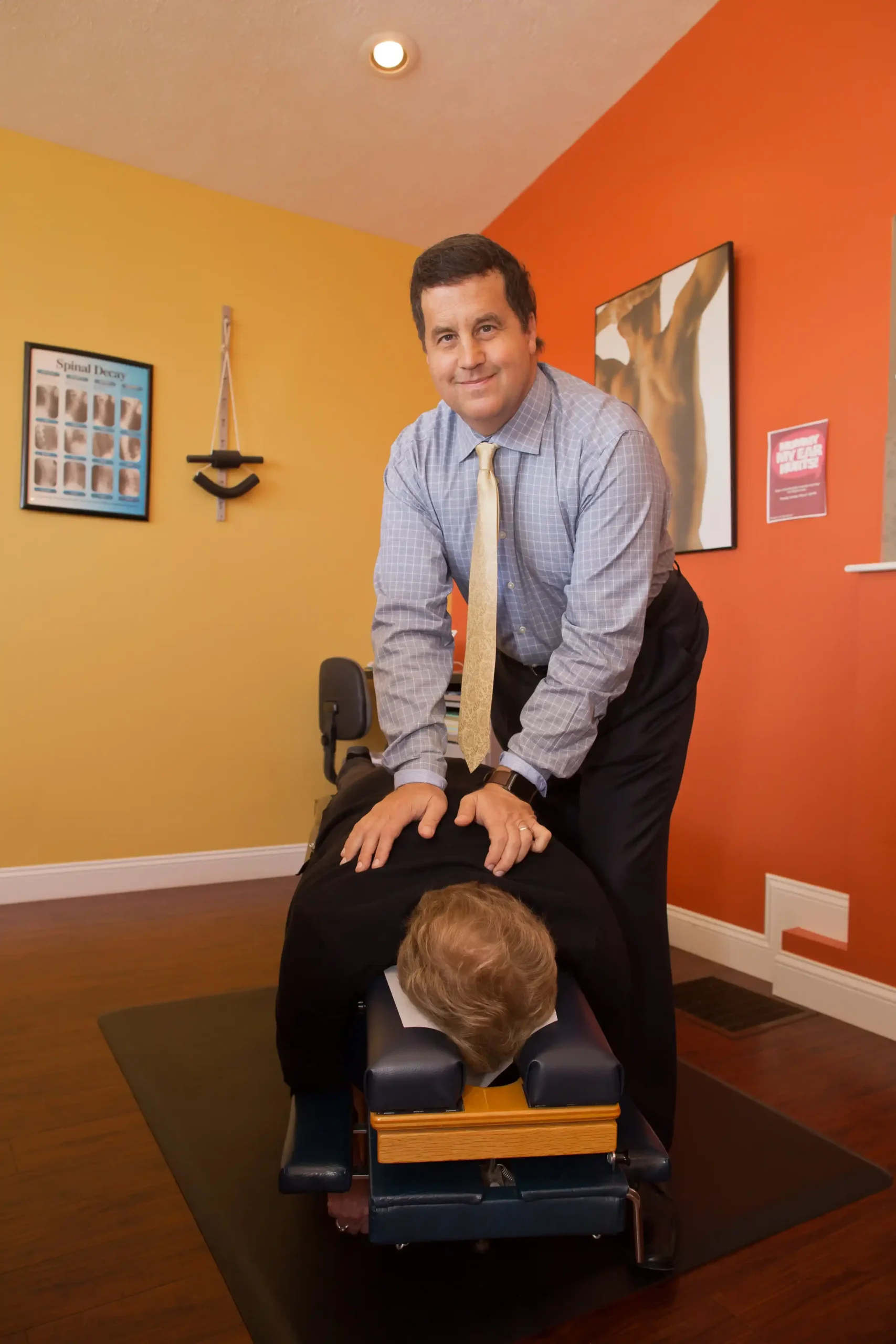
At that point, addressing the underlying dysfunction is what makes the difference. At Kaurich Chiropractic & Wellness Center in South Bend, Dr. Kevin Kaurich helps desk workers and office professionals address the neck pain, back pain, and postural problems that build up from years at a workstation – correcting the joint and muscle issues that good ergonomics alone can’t undo, and offering practical guidance to keep them from coming back.
If desk-related back or neck pain has been wearing on you, whether you sit, stand, or both, reach out online or call our South Bend office at 574-282-2828.